Disclosure: This article is published by ORIZI Group and may refer to our own manufacturing experience, services and capabilities. External factual claims are supported by cited sources.
The Philippines is one of Southeast Asia’s most active markets for small-batch cosmetic contract manufacturing, but it is rarely examined by brand owners outside the country. This guide explains how the Philippine sector is structured, how the Philippine Food and Drug Administration regulates it, and which eight OEM/ODM suppliers passed a licence and website check on 18 September 2026.
Quick answer
The Philippines has a large, licence-based cosmetic contract-manufacturing sector clustered around Metro Manila, in Cavite, Laguna, Bulacan and Nueva Ecija. The eight suppliers profiled below range from stock-formula private-label plants with published minimums of 250 kg of bulk to ISO 22716-certified manufacturers with food and drug licences. Cosmetics are regulated by the Philippine FDA under the ASEAN Cosmetic Directive, so every plant needs a License to Operate and every product needs a notification. The sector suits brands selling in the Philippines and wider ASEAN.
Key takeaways
- A Philippine cosmetic manufacturer’s licence can be verified by anyone on the FDA’s public portal, which shows the licensed activity, plant address and validity date.
- The market is built around stock formulas and relabelling, which keeps first-order minimums low but limits product exclusivity.
- Because the Philippines applies the ASEAN Cosmetic Directive, a Philippine-made formula generally meets the same ingredient rules as in Malaysia, Thailand, Indonesia and Vietnam, but each country still requires its own notification.
- Three Philippine halal certification bodies appear on JAKIM’s January 2026 list of recognised foreign certifiers, but only a minority of contract plants publish halal certification.
- Several licensed Philippine plants have little or no working web presence, so a missing website is common and should be checked against the FDA record rather than taken at face value.
Table of Contents
- Why the Philippine market matters to brand owners
- How the Philippine FDA regulates cosmetic products
- Eight Philippine cosmetic OEM/ODM suppliers
- What to compare when evaluating any manufacturer
- Looking beyond the Philippines for a manufacturing partner?
- Frequently asked questions
Why the Philippine market matters to brand owners
The Philippines has more than 110 million consumers and one of the most active online beauty markets in the region. Much of that demand is served by a “rebranding” industry: small and mid-sized brands, resellers and clinics that buy ready-made or lightly customised formulas from licensed contract manufacturers and sell them under their own names. The manufacturers that support this model sit mainly in the industrial belt around Metro Manila, from Cavite and Laguna in the south to Bulacan, Pampanga and Nueva Ecija in the north.
The sector has clear strengths. Minimum orders on stock formulas are low. Brightening care, herbal and coconut-based formulations, soap and hair treatments are well established. Most suppliers work in English. The weaknesses are equally clear. Quality systems vary widely between plants, many small factories market themselves through social media rather than websites, and a stock formula bought by one brand may also be sold to its competitors.
How the Philippine FDA regulates cosmetic products
Cosmetic products in the Philippines are regulated by the Food and Drug Administration (FDA) Philippines under the Food and Drug Administration Act of 2009 (Republic Act No. 9711). Within the FDA, cosmetics fall under the Center for Cosmetics and Household/Urban Hazardous Substances Regulation and Research. As an ASEAN member state, the Philippines applies the ASEAN Cosmetic Directive, including its ingredient annexes, labelling requirements and ASEAN cosmetic GMP guideline.
A License to Operate (LTO) is the establishment licence that allows a company to manufacture, trade, import or distribute cosmetics in the Philippines. Each licence records a specific activity, so a Cosmetic Manufacturer licence and a Cosmetic Trader licence are different permissions. A Cosmetic Product Notification is the separate, product-level filing that must be made before a cosmetic is placed on the Philippine market. Both can be checked on the FDA’s public verification portal.
Online enforcement has become stricter. With the Internet Transactions Act (Republic Act No. 11967) in force, Philippine manufacturers now advise clients that cosmetics sold on major marketplaces need a valid FDA notification. For brands planning halal claims, JAKIM’s list of recognised foreign halal certification bodies (as at 30 January 2026) names three Philippine bodies: the Islamic Da’wah Council of the Philippines (IDCP), the Halal Development Institute of the Philippines (HDIP) and the Halal International Chamber of Commerce and Industries of the Philippines (HICCIP).
Eight Philippine cosmetic OEM/ODM suppliers
Each supplier below offers toll, contract or private-label manufacturing to outside brands, leads with cosmetics or personal care, and either returned an approved Cosmetic Manufacturer licence on the FDA verification portal on 18 September 2026 or publishes its licence number on its own website. Suppliers are listed alphabetically; the order is not a ranking.
A.M. Rieta Corporation
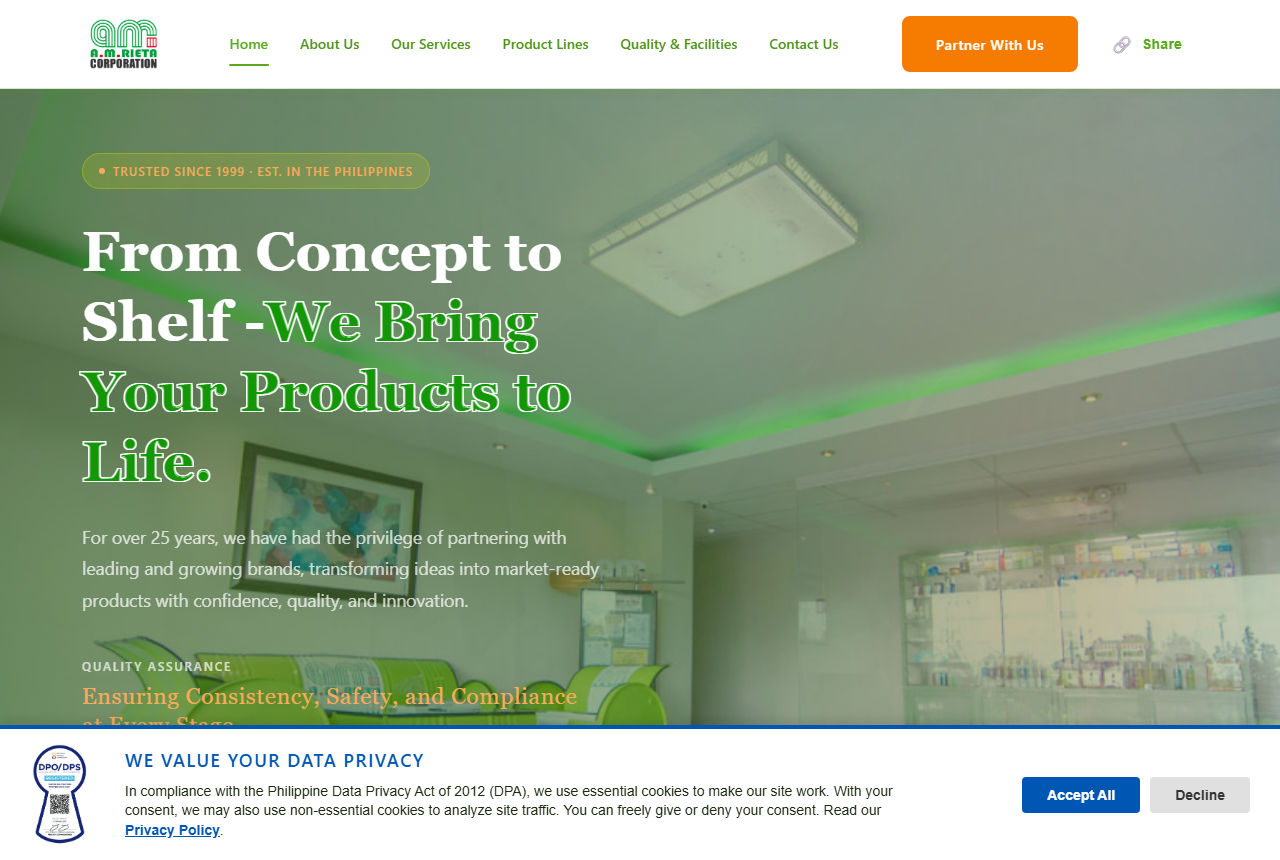
A.M. Rieta Corporation is an ODM and contract manufacturer in Kawit, Cavite, founded in 1999, that states ISO 22716 certification since 2007 and halal certification. Its range spans skin, hair, bath, baby and deodorant products through to cosmetic drugs and pet grooming. The FDA portal shows an approved Cosmetic Manufacturer licence valid to September 2027.
Website: amrietacorporation.com
Arkana Laboratories
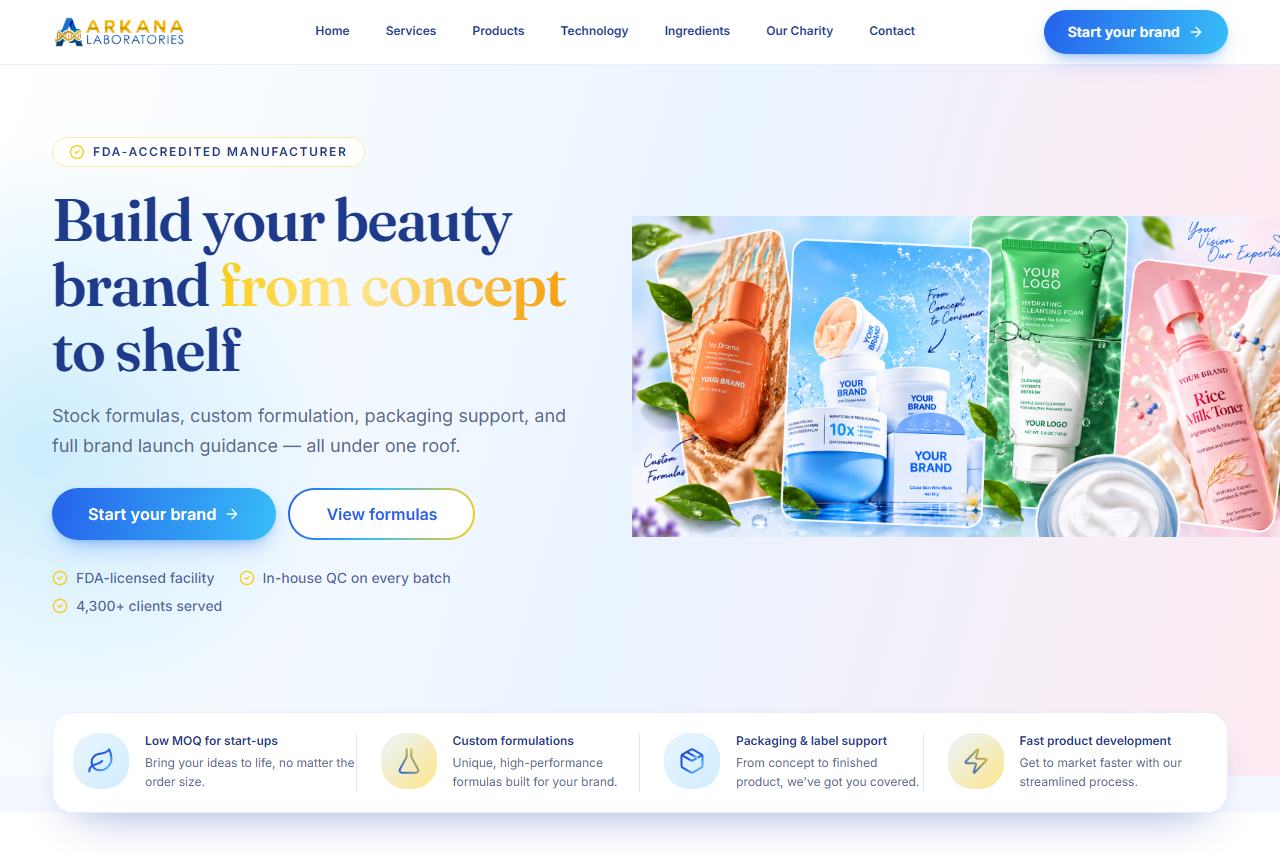
Arkana Laboratories, operated by 888 Dragonaire Corp., is a private-label manufacturer in Cabanatuan City, Nueva Ecija, offering stock formulas, custom formulation and FDA documentation support to start-up brands. It states that it has served more than 4,300 clients. Its FDA licence records showed a validity date of 11 October 2026 at the time of our check.
Website: arkanamfg.com
Kosmetics Technologies
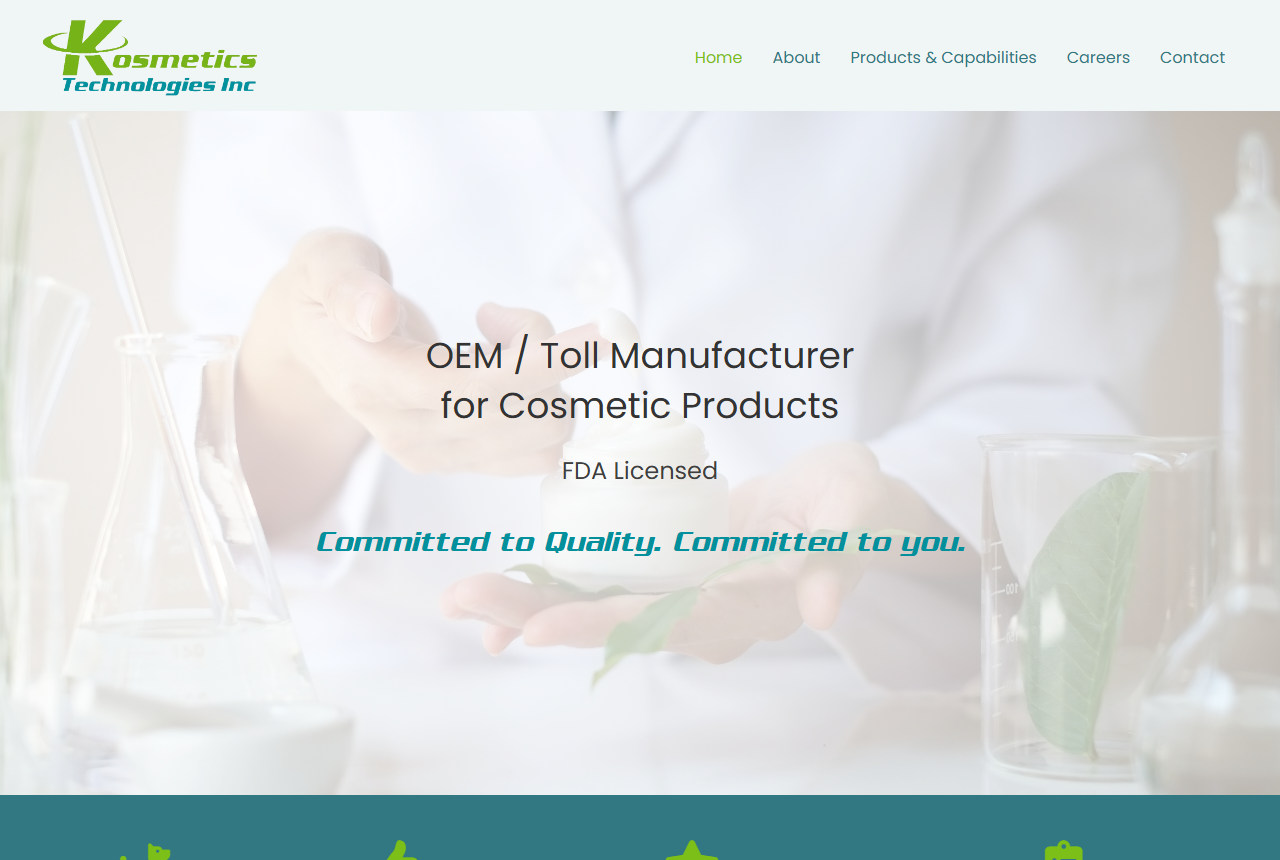
Kosmetics Technologies Inc. is an OEM and toll manufacturer in Quezon City that states it manufactures for more than twenty brands, with particular depth in salon and spa hair treatments, body care and hand and foot care. It publishes an FDA licence number in an older format that the portal’s name search did not return in our check.
Website: kosmetics.ph
Orsolab
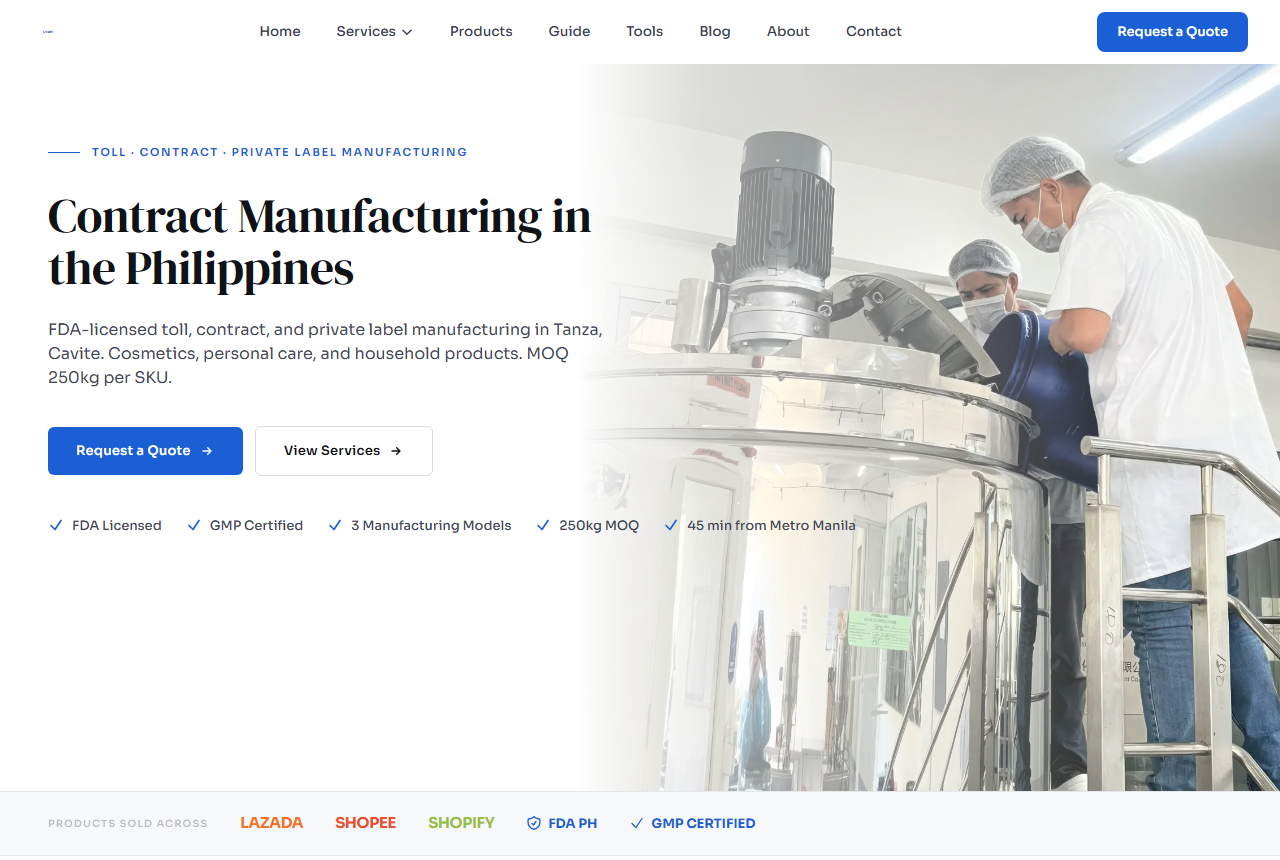
Orsolab Inc. is a toll, contract and private-label manufacturer in Tanza, Cavite that publishes a minimum of 250 kg of bulk per product and serves retailers, hotels and aesthetic clinics. It publishes its cosmetics licence number and a separate household-products licence; the portal’s name search did not return its record in our check.
Website: orsolabinc.com
Rainiers Research & Development Institute
Rainiers Research & Development Institute, Inc. is a Filipino-owned product developer and toll manufacturer in Caloocan, Metro Manila, founded in 1989, specialising in herbal formulations based on Philippine botanicals. It displays IDCP halal and GMP marks and holds an approved Cosmetic Manufacturer licence valid to January 2028, alongside a drug-manufacturing licence obtained in 2022.
Website: rainiersresearch.com
Refinette Cosmetic Manufacturing Corporation
Refinette Cosmetic Manufacturing Corporation is an R&D-led contract manufacturer in Guiguinto, Bulacan, stating 33 years of operation, more than 500 staff and certification to ISO 9001:2015 and ISO 22716:2007. It produces soaps, skincare, colour cosmetics, cosmetic drugs and nutraceuticals, and its Cosmetic Manufacturer licence is valid to July 2037.
Website: refinette.net
Universal Skin Cosmeceuticals
Universal Skin Cosmeceuticals Ltd. Co. is a contract and private-label manufacturer with its plant in Bacoor, Cavite, offering toll manufacturing, all-in production, hundreds of stock formulas and custom development under the ASEAN cosmetic GMP guideline. Its Cosmetic Manufacturer licence is valid to November 2027.
Website: usclcph.com
Z Lab International
Z Lab International Corporation is a beauty and personal-care manufacturer in Santa Rosa, Laguna that offers ready-made products for relabelling alongside sourcing and formulation services. Its Cosmetic Manufacturer licence is valid to November 2027, although several interior pages of its website were not loading when we checked.
Website: zlab.com.ph
What to compare when evaluating any manufacturer
The Philippine market shows why a licence check should come before a price comparison. Of the licensed plants we looked at, three had websites that were blocked, expired or unreachable, while two active private-label businesses returned no manufacturer licence under their own names. The table below sets out the checks that separate a qualified supplier from a convincing sales page, in the Philippines or anywhere else.
| Check | What a satisfactory answer looks like | Common warning sign |
|---|---|---|
| Establishment licence | Approved licence for manufacturing (not trading) at the plant address you are shown, valid beyond your first run | A trader or distributor licence at an office address |
| GMP evidence | An ISO 22716 certificate or regulator GMP record naming the site, scope and expiry | “GMP compliant” with no certificate or audit record |
| Formula exclusivity | Written terms on whether the formula is exclusive and who owns development work | A stock formula presented as a custom development |
| Notification ownership | Agreement on whose name the product notification is filed in, in each market | Notifications held by the factory, making a later switch slow |
| Minimum order | A minimum for every component on the bill of materials, not only the bulk | A low bulk minimum hiding a 10,000-piece packaging minimum |
| Halal status | Certifier name, certificate scope and recognition in the target market | A halal logo with no named certifier |
The same checks framed our earlier overview of cosmetic suppliers in South Africa, a market with no pre-market registration at all, which makes an instructive contrast with the licence-heavy Philippine system.
Looking Beyond the Philippines for a Manufacturing Partner?
Philippine contract manufacturing fits a clear brief: a brand selling mainly in the Philippines, a reseller launching from stock formulas, or a product built on Philippine botanicals. For brands that want a single ASEAN manufacturing base with certified cosmetics GMP, halal certification and regulatory support under one roof, a Malaysian manufacturer is often the simpler route. That is where ORIZI Group works.
ORIZI Group is a Malaysia-based OEM and ODM manufacturer of cosmetics, skincare and personal care products, operating to ISO 22716 cosmetics GMP and holding halal certification. Brands can work with us through OEM cosmetics manufacturing from their own or newly developed formulas, or through our private label and ODM route using developed formulations.
From our own project work, the point where ASEAN expansion most often stalls is not the formula but the paperwork behind it. Because Malaysia and the Philippines follow the same ASEAN Cosmetic Directive, a product made and notified in Malaysia can usually be notified in the Philippines without reformulation, but only if the ingredient disclosure, product information file and label artwork are prepared with the second market in mind from the start. Our regulatory affairs consulting team plans for that during development. This observation comes from our own client projects rather than a market study, and each market’s importer and labelling requirements still apply. To plan a multi-market ASEAN launch, talk to our team.
Frequently asked questions
Do cosmetics need FDA approval in the Philippines?
Cosmetics in the Philippines need a Cosmetic Product Notification filed with the FDA before they are sold, and every manufacturer, trader and distributor involved needs a License to Operate for its activity. Notification is not a pre-market safety approval of the formula; responsibility for compliance with the ASEAN Cosmetic Directive stays with the company that files it.
How can I check whether a Philippine cosmetic manufacturer is licensed?
Search the company’s registered name on the FDA verification portal at verification.fda.gov.ph. A licensed plant appears with its LTO number, the activity “Cosmetic Manufacturer”, its address, an “Approved” decision and a validity date. If no record appears, ask the company for its licence certificate and search the number directly.
What is the minimum order for private label cosmetics in the Philippines?
Minimums on stock formulas are low compared with most of the region. Orsolab, for example, publishes 250 kg of bulk per product, which it says fills roughly 1,250 to 8,300 units depending on pack size. Custom formulations and printed packaging usually raise the effective minimum, so confirm a figure for every component.
Are Philippine halal certificates recognised in Malaysia?
Certificates from JAKIM-recognised Philippine bodies, which as at 30 January 2026 were IDCP, HDIP and HICCIP, can support a halal claim on products imported into Malaysia. The certificate must cover the specific product and facility and be current. A foreign certificate does not authorise use of Malaysia’s JAKIM halal logo.
Conclusion
The Philippine cosmetic contract-manufacturing sector is larger and more accessible than its international profile suggests, and its public licence register gives buyers a verification tool that many markets lack. The eight suppliers profiled here are a reasonable starting shortlist for Philippine and ASEAN launches. The more important habit they illustrate applies everywhere: check the licence, the certificate and the ownership terms before the price.
Sources: the eight manufacturers’ published websites (reviewed 18 September 2026); the Philippine FDA verification portal (searched 18 September 2026); Republic Acts No. 9711 and No. 11967; the ASEAN Cosmetic Directive via HSA Singapore; JAKIM’s list of recognised foreign halal certification bodies as at 30 January 2026. Limitations: this is desk research based on the companies’ own published material and public licence records. No factory was audited, no quality system inspected and no samples produced. The FDA portal matches registered entity names, so a missing search result does not by itself mean a company is unlicensed. Regulatory summaries are general information, not legal advice. Update history: September 2026, first published.